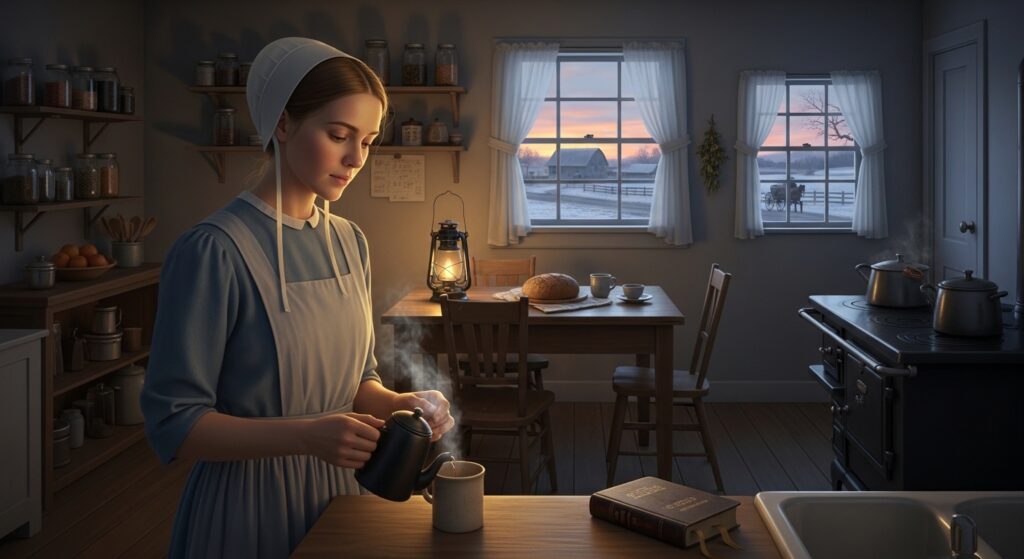
The kettle whistles on Anna’s gas-powered stove—not an electric one, of course. Outside her kitchen window, the eastern sky is just beginning to lighten over the Lancaster County farmland. It’s 4:15 in the morning, and another day has begun.
Before Dawn: The First Chores
Anna doesn’t hit a snooze button. There isn’t one. Instead, her eyes open naturally, as they have every morning since she was a girl. The first task is lighting the kerosene lanterns—those familiar glass chimneys that cast their warm, soft glow across her kitchen . Her husband Jacob is already pulling on his boots, headed for the barn to tend the horses and milk the cows. Their boys, ages eight and ten, stumble sleepily behind him. They’re learning the rhythm of this life.
Anna wraps her shawl around her shoulders and steps outside. The air is crisp and clean. She walks the familiar path to the chicken coop, gathering eggs into her basket while the hens cluck their morning complaints. From the barn, she hears Jacob’s low voice guiding the boys, the rhythmic sound of milk streaming into pails. By the time she returns to the kitchen, the fire is crackling and water is heating for coffee.
At 5:00 sharp, Anna steps outside and rings the iron triangle. Its clear note carries across the yard, calling her men in from their chores . They file in, cheeks rosy from the cold, and settle around the table. Anna sets down plates heaped with eggs, fresh bread still warm from yesterday’s baking, and preserves she put up last summer. Jacob bows his head. The boys follow. They eat in comfortable silence, the way people do when words aren’t necessary.
Midday: The Rhythm of the Home
After breakfast, the real work begins. Anna washes the dishes by hand in the deep porcelain sink—no dishwasher here, and she doesn’t miss one. She sweeps the wide plank floors with a broom made by the elderly man three farms over . The boys have gone to the one-room schoolhouse down the road, and the house feels quiet without them.
By mid-morning, Anna is in the garden. It’s June, which means the weeds are ambitious and the beans need trellising. She works her way down the rows, her hands in the soil, her knees on the straw she’s laid between the plants. “It doesn’t pay to hurry,” her mother always said, and Anna has learned it’s true . When she rushes, she makes mistakes. When she moves slowly and steadily, the work gets done right.
Around noon, Jacob appears with a jug of water. They sit together on the back steps, looking out at the fields, at the garden, at the life they’re building. He doesn’t say much—he never has—but his hand finds hers, and that’s enough.
In the afternoon, Anna turns to canning. The green beans are coming in faster than the family can eat them, so she fires up the big pot and fills jar after jar with beans, water, salt. The kitchen steams. The jars ping as they seal. By the time the boys burst through the door at 3:30, thirty jars of green beans are cooling on the counter, and Anna is kneading dough for tomorrow’s bread.
Afternoon: The Blessing of Community
Today is Wednesday, and on Wednesdays, the women gather.
Anna wipes the flour from her hands and walks to the barn loft, where six of her neighbors are already assembled around a quilting frame. Miriam, the oldest, directs the placement of colors with the authority of someone who has been quilting for sixty years. Young Sarah, newly married, watches carefully and learns.
They quilt and they talk. About the garden. About the children. About the elderly Mrs. Beiler, who needs someone to check on her daily. About the young couple expecting their first baby in the fall. Anna listens more than she speaks—that’s her way—but when she does offer a thought, the others pause to hear it.
This is the frolic, the gathering of women to accomplish together what would be lonely alone . They’ll finish this quilt in two more Wednesdays, and it will keep some family warm through the coming winter. Every stitch is small. Together, they become something lasting.
Evening: Quilting by Lamplight
Supper is simple—leftovers from yesterday, fresh bread, milk from their own cows. The boys chatter about their day, about the spotted frog they found in the creek, about the spelling test Levi almost aced. Jacob listens, asks questions, nods. He’s teaching them, in his quiet way, how to be men.
After supper, Anna washes dishes while the boys do their evening chores. When they’re done, the family gathers in the front room. Jacob reads a chapter from the German Bible—the old words, the familiar stories, the ones Anna has heard since she was small enough to sit on her father’s lap. They kneel for silent prayer.
Then the boys climb the stairs to bed, and Anna pulls out her mending basket. Jacob works on a harness that needs repair. The kerosene lamp burns low between them, casting shadows on the walls.
“You worked hard today,” Jacob says. It’s not a question. It’s an observation, a statement of fact, a quiet acknowledgment.
Anna smiles. “So did you.”
He reaches across and squeezes her hand. That’s all. It’s enough.
At 9:30, Anna blows out the lamp. She climbs the stairs to join Jacob, already asleep, and lies in the darkness listening to the house settle around her. The boys’ soft breathing from the next room. The creak of old beams. The distant hoot of an owl.
Tomorrow will begin early—but that’s all right. There’s a deep satisfaction in this life: the work of her hands, the warmth of her family, the rhythm of seasons turning, and the quiet knowledge that in doing these ordinary things faithfully, she is exactly where she belongs.
Anna’s life moves at a different pace—slower, steadier, rooted in the soil and the seasons. It’s a rhythm millions of Amish women still keep across America, from Pennsylvania to Ohio to Wisconsin. And in its own way, it sings.