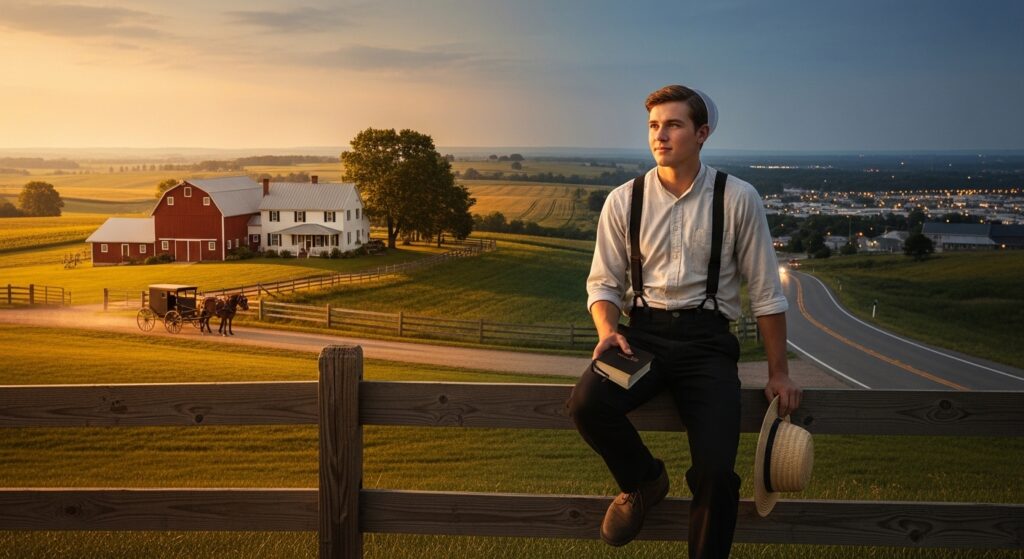
If you’ve ever watched a TV drama or picked up a popular novel featuring Amish characters, you’ve probably encountered the concept of Rumspringa—that mysterious “year off” when Amish teenagers supposedly leave home, party wildly, and decide whether to return to the community or embrace the “English” world forever.
It makes for compelling storytelling.
But like so much about Amish culture that filters into mainstream awareness, the popular image of Rumspringa is more fiction than fact . As someone who writes Amish Christian romance, I believe it’s important to understand the reality behind the myth—both for authenticity in storytelling and for genuine appreciation of this fascinating faith community.
So, what is Rumspringa really?
The Literal Meaning: “Running Around”
Let’s start with the word itself. Rumspringa (pronounced “ROOM-shpring-uh”) comes from Pennsylvania German and literally means “running around” or “jumping around” . It’s a cousin to the modern German word herumspringen . Far from being an official institution or formal rite of passage, the term simply describes the period of adolescence—those teenage years when young people are, well, running around .
In many Amish communities, Rumspringa begins around age 16 and continues until a young person decides to marry and join the church through adult baptism . And here’s the crucial distinction: during this time, teens are not yet church members and therefore haven’t taken the vow to follow the Ordnung—the set of unwritten community rules that govern Amish life .
But they are still very much under their parents’ authority. There is no formal “release” from family rules .
What Actually Happens During Rumspringa
For the majority of Amish youth, Rumspringa looks nothing like the wild party scenes depicted on television. In fact, approximately half of teens in larger communities—and the majority in smaller ones—continue to dress and behave within Amish norms throughout their adolescence .
So what does it actually involve?
For most teens: Rumspringa means attending Sunday night singings (the traditional gathering place for young people to socialize and court), participating in youth groups, playing volleyball with friends, and gradually taking on more adult responsibilities . Their social circles broaden, and they may attend events with peers from neighboring church districts. But they remain at home, continue working alongside their families, and still attend church services.
For a minority: Yes, some teens do experiment with things their parents don’t permit—wearing “English” clothes, using cell phones, driving cars (in communities that typically don’t allow them), and occasionally alcohol or drugs . In larger Amish settlements like Lancaster County, Pennsylvania, or Holmes County, Ohio, the sheer number of Amish youth means a distinct teen subculture can emerge .
But here’s what the TV shows don’t tell you: parents don’t condone this behavior . The idea that Amish families encourage their teens to go out and “sow wild oats” is a complete misconception. Amish parents hope and pray their children will choose to follow the faith they’ve been taught, just as any devout parents would .
The Decision: To Join or Not to Join
The heart of Rumspringa—and where the popular myth gets closest to truth—is that this period does culminate in a genuine choice.
Because Amish faith requires adult baptism, young people must eventually decide for themselves whether to make that lifelong commitment. And it truly is a lifetime commitment. Once baptized, leaving the church means facing shunning (Meidung)—being socially separated from everything and everyone you’ve known .
Here’s what the statistics show: Approximately 80-90% of Amish teenagers ultimately choose to be baptized and remain in the church . That’s an astonishing retention rate by any measure. The numbers vary by community—more conservative groups like the Swartzentruber Amish have even higher retention, while some larger settlements see slightly more youth leave .
Those who do leave aren’t typically “shunned” in the way popular culture portrays. You can’t be excommunicated from something you never joined . Many who don’t join the Amish church may choose a more progressive Mennonite congregation, maintaining relationships with family while embracing a different lifestyle .
Why the Myths Persist
If Rumspringa is really just adolescence with a Pennsylvania German name, why does the “wild party” image dominate popular culture?
Several reasons:
Sensational storytelling. The 2002 documentary Devil’s Playground and subsequent reality shows like Amish in the City focused on the most extreme examples because, well, that’s more interesting television . As one expert notes, “The public interest in Rumspringa would be a lot less if books and documentaries didn’t focus on the most extreme examples” .
The fascination with contrast. There’s something compelling about the image of a young person in plain dress suddenly immersed in modern culture. It makes for powerful visual storytelling.
Misunderstanding of choice. The idea that Amish youth “choose” their faith resonates with American values of individual freedom. But framing it as a one-time, high-stakes decision oversimplifies a much more gradual process of discernment.
Limited authentic voices. Until recently, most writing about the Amish came from outside observers, not from within the community itself .
A Note on Authentic Sources
I want to acknowledge something important as we close. Most of what’s written about the Amish—including this blog post—comes from external sources: scholars, journalists, and observers. Even the experts cited here, while highly knowledgeable, are not themselves Amish .
There are increasing efforts to amplify voices of those who have left Amish communities and can speak to their experiences authentically. Organizations like the Amish Heritage Foundation, founded by a former community member, work to correct misconceptions and advocate for those who’ve left . These voices remind us that behind every cultural practice are real people—with complex experiences that don’t always fit neatly into either the “quaint simplicity” narrative or the “wild rebellion” myth.
What Rumspringa Teaches Us
Perhaps the most beautiful truth about Rumspringa is what it reveals about Amish faith itself. This is a tradition that takes adult commitment seriously enough to let young people choose it freely. The choice to be baptized isn’t automatic—it’s deliberate, informed, and lifelong.
And remarkably, generation after generation, the vast majority choose to remain.
That speaks to something powerful about community, belonging, and faith. It speaks to a life that, for all its restrictions, offers deep meaning and connection. It speaks to the quiet strength of a people who have maintained their distinct identity for centuries, not through coercion, but through the compelling power of a life lived in intentional community.
In my Amish romance novels, I try to honor that complexity—the genuine faith, the tight-knit community, the real struggles, and the beautiful humanity of people who have chosen a different path. Because at the end of the day, whether we’re Amish or “English,” we’re all just trying to find our way home.
Have you encountered Rumspringa in fiction or film? What questions do you still have about Amish life? Drop them in the comments—I’d love to explore more in future posts.
Quick Rumspringa Facts:
· Age range: Begins around 16, continues until baptism (usually early 20s)
· Literal meaning: “Running around”
· Baptism rate: 80-90% of youth choose to join the church
· Key purpose: Time for courtship and discerning adult commitment to faith
· Not: A sanctioned “year off” or parental-approved party period